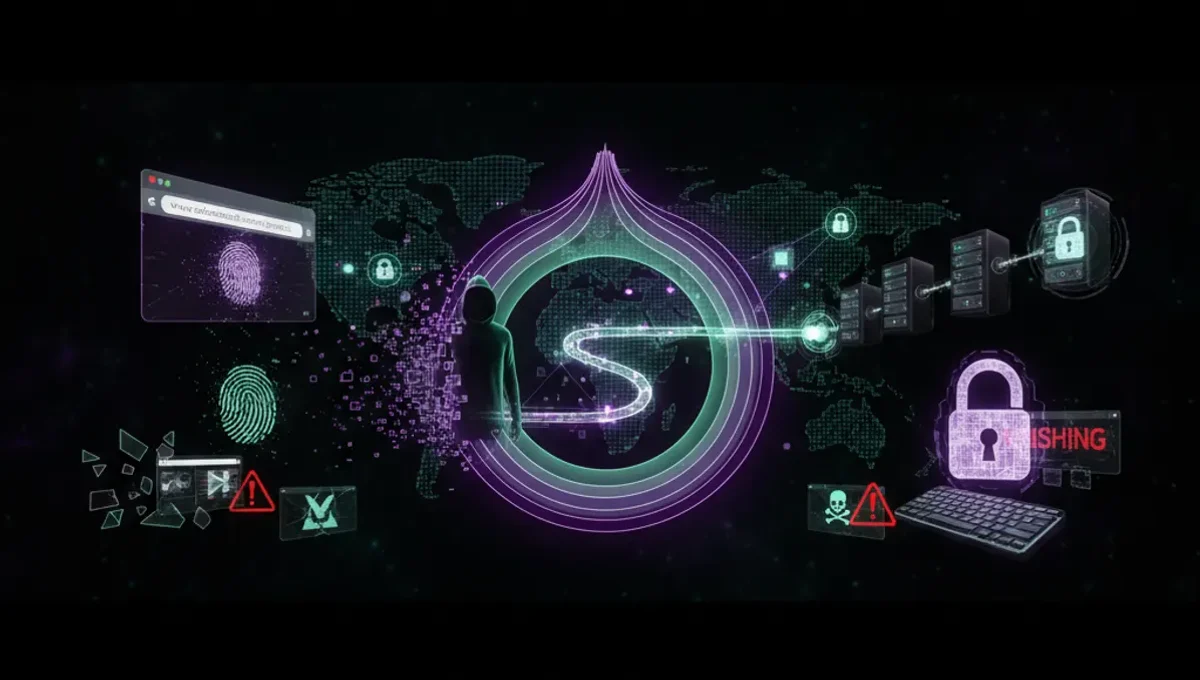
What a Dark Web Address Actually Is
An onion address is a cryptographic identifier, not a domain name registered with a registrar. When someone runs a hidden service on Tor, the network generates a public key and derives a .onion address from it. This address is deterministic: the same service always produces the same address, which is why verification matters.
Unlike DNS, which translates example.com to an IP address through a central registry, onion addresses contain the routing information themselves. When you connect to an address like thehiddenwiki.onion, your Tor client decrypts the address, finds the introduction points, and establishes a circuit to the hidden service. No ISP, no DNS server, and no central authority knows which .onion address you're contacting.
Why Dark Web Site Addresses Are Difficult to Remember
The 56-character format exists for security, not convenience. Tor generates these addresses from public keys using cryptographic hashing, which produces seemingly random output. A shorter address would be easier to type but would sacrifice the security properties that make onion services resistant to impersonation.
V2 addresses, the older standard, were 16 characters long. They were deprecated because researchers discovered that the shorter format made it feasible to generate many keys until finding one that matched a target pattern, allowing attackers to create lookalike addresses. V3 addresses, introduced around 2019, use stronger cryptography and require vastly more computational effort to forge, making them safer for high-value targets like news organizations and whistleblowing platforms.
How to Verify a Legitimate Onion Address
Verification depends on the source. For official projects and news organizations, check their clearnet website for a PGP-signed announcement or a link in their official social media accounts. The Tor Project publishes its onion address on torproject.org. ProPublica and other news outlets post their addresses on their main sites.
For forums and marketplaces, the risk is higher. Phishing clones are common: attackers register similar-looking addresses and host fake login pages to steal credentials. If you find an address on Reddit or a forum post, cross-reference it with multiple independent sources. Check whether the site operator has published a PGP fingerprint; you can verify the address against that fingerprint using Tor's documentation. Never assume an address is real just because it appears in search results or a directory.
The Reality of Finding Dark Web Addresses
Tor does not have a built-in search engine or directory. The Hidden Wiki and similar directories are user-maintained wikis with links, but they are not authoritative and often contain outdated or malicious entries. Many addresses listed there have been offline for years or are honeypots run by law enforcement.
According to Tor Project documentation, the network's design intentionally makes discovery difficult: hidden services are not meant to be passively discoverable. If you want to access a specific service, you need to know its address beforehand, usually through a trusted source outside Tor. This friction is a feature, not a bug. It prevents casual browsing and reduces the surface area for scams. The best dark web apps and best dark web browser configurations emphasize this principle: security through obscurity and deliberate access control.
Common Mistakes When Handling Onion Addresses
One frequent error is copying an address from an untrusted source and assuming it's correct. Typos in a single character produce a completely different address, and Tor will not warn you that you've reached the wrong destination. Another mistake is visiting an onion address without keeping your Tor browser updated; older versions have known vulnerabilities that can leak your IP address.
A third mistake is mixing onion addresses with other browsing habits. If you log into a personal account on an onion site while using the same username elsewhere, you've linked your identity across networks. Best dark web pages and best dark web search practices recommend using separate browser profiles or even separate operating systems for sensitive onion browsing. The best dark web browser setup includes disabling JavaScript, using a VPN before Tor (if your threat model requires it), and never maximizing your browser window, which can reveal your screen resolution to websites.
Reality Check: How Addresses Get Compromised
Law enforcement has seized onion addresses by identifying the server's physical location through traffic analysis, subpoenaing hosting providers, or infiltrating the service itself. Court records from market seizures show that operators sometimes made operational security mistakes: reusing usernames across platforms, logging into clearnet email accounts from the same network, or storing unencrypted records on the server.
According to public law-enforcement press releases, phishing attacks targeting onion address users are common. Attackers send messages claiming to be from a service, asking users to verify their account by visiting a link. The link points to a clone address hosted on a different server. Users who enter credentials lose access to their accounts. This matters because it means that even if you have the correct address today, a future message claiming to be from that service may be a phishing attempt. Always navigate directly to the address you have verified, never by clicking links in messages.
Taking the Next Step: Verification and Safe Access
If you need to access a specific onion service, start by finding the address through an official channel: the organization's clearnet website, a PGP-signed announcement, or a trusted contact who has verified it independently. Write down the address or store it in a password manager dedicated to onion links, separate from your regular passwords.
Before visiting, ensure your Tor browser is fully updated and that you understand the service's security model. Some onion sites require JavaScript for functionality; others disable it by default for security. Read any security warnings the site displays. If you're accessing a marketplace or forum, assume that law enforcement monitors it and that your activity could be logged. Use a username that does not match any of your other online identities. If the site offers PGP-based communication, use it. The goal is not to hide from the site operator, but to compartmentalize your online presence and reduce the risk that a breach or seizure exposes your real identity.
Frequently asked questions
How do I know if a dark web address is real or a phishing clone
Verify the address through an official source: the organization's clearnet website, a PGP-signed announcement, or a trusted contact. Check whether the site operator has published a PGP fingerprint and verify the address against it. Never click links in messages claiming to be from the service; navigate directly to the address you have verified. If the site looks identical to another but the address is different, it is likely a clone.
Why are dark web addresses so long and random
Onion addresses are derived from cryptographic keys, not registered through a central authority. The 56-character format provides security against impersonation attacks. Shorter addresses would be easier to remember but would allow attackers to generate lookalike addresses more easily. The randomness is intentional and necessary for the security model to work.
Can I search for dark web addresses like I search the regular web
No. Tor does not have a built-in search engine, and the network's design intentionally makes discovery difficult. Directories like the Hidden Wiki exist but are user-maintained and often contain outdated or malicious entries. If you want to access a specific service, you need to know its address beforehand from a trusted source outside Tor.
What should I do if I find a dark web address on Reddit or a forum
Cross-reference it with multiple independent sources before visiting. Check the organization's official website for a confirmed address. Be aware that addresses shared on public forums may be outdated, fake, or honeypots. If you cannot verify the address through an official channel, do not visit it.
Do I need a VPN before using Tor to access onion addresses
A VPN before Tor is optional and depends on your threat model. It can hide the fact that you are using Tor from your ISP, but it introduces a potential point of failure if the VPN provider logs traffic. The Tor Project recommends using Tor alone for most users. If you use a VPN, choose one with a no-logging policy and understand that you are trusting the VPN provider with your traffic.