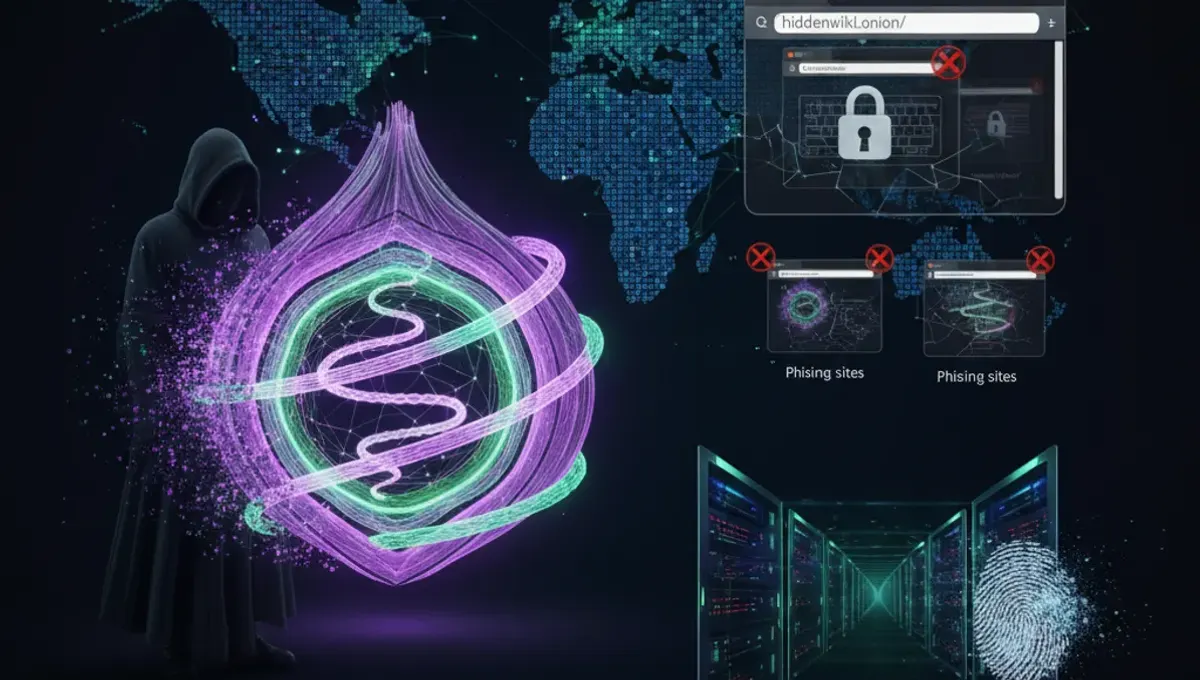
What Are Onion Dark Web Sites
An onion site is a web service that runs on the Tor network and is identified by a .onion domain name instead of a traditional .com or .org address. The name comes from Tor's onion routing protocol, which layers encryption in multiple rounds, like peeling an onion. These sites are not indexed by search engines and are not accessible through a regular browser; you must use the Tor browser to reach them.
Onion dark web sites can host anything from a personal blog to a forum to a marketplace. The Tor network itself is neutral technology; what makes a site appear on the dark web is simply that it is hosted on Tor infrastructure and intentionally hidden from the regular internet. The anonymity works in both directions: visitors cannot easily identify the site operator, and the operator cannot easily identify visitors. This mutual obscurity is the core feature that draws both legitimate users and criminals.
How Onion Addresses and Tor Routing Work
A .onion address is a cryptographic identifier, not a human-readable domain. Early onion addresses were 16 characters long (for example, thehiddenwiki.onion); newer v3 addresses are 56 characters and use stronger encryption. When you visit a .onion site through the Tor browser, your connection is routed through a series of Tor relays, each one stripping away a layer of encryption, so that no single relay knows both your location and the destination.
The site operator sets up a Tor hidden service on their server, which generates the .onion address and publishes it only to people they trust or to the public, depending on their intent. The Tor Project documentation explains that this architecture makes it extremely difficult for an attacker or law-enforcement agency to identify the server's physical location without compromising the server itself or the operator's operational security. This is why onion dark web sites have historically been used by whistleblowers, journalists, and political dissidents in countries with heavy censorship.
Legitimate Uses and Services on Onion Networks
Many organizations and individuals run onion sites for defensible reasons. News outlets like major international media organizations operate onion mirrors to allow sources in repressive countries to submit tips securely. Libraries and archives host onion versions of their content to preserve access in regions where the regular internet is censored or monitored. Privacy-focused email providers, messaging platforms, and discussion forums operate on Tor to protect user communications from mass surveillance.
The Tor Project itself publishes a list of official onion services, including their own website mirror. Whistleblowing platforms and human rights organizations use onion sites to receive reports from people who cannot risk being identified. Academic researchers study onion services to understand privacy technology and network resilience. These legitimate uses demonstrate that the onion dark web is not inherently criminal; the technology enables privacy and free speech for people who genuinely need it.
Illegal Marketplaces and Dark Web Onion Sites
The same anonymity that protects journalists also shields criminals. Onion dark web sites have hosted illegal marketplaces where people buy and sell drugs, stolen data, counterfeit documents, and other contraband. These marketplaces typically operated as forums or storefronts where vendors posted listings, users placed orders, and transactions were conducted in cryptocurrency to avoid financial tracking.
Law-enforcement agencies have successfully identified and shut down major onion marketplaces by compromising the server, tricking the operator into revealing their location, or pursuing financial trails through cryptocurrency exchanges. Court records and public law-enforcement press releases show that running an onion marketplace does not guarantee anonymity; operational security failures, human mistakes, and technical vulnerabilities have led to arrests and convictions. The closure of these sites demonstrates that the dark web onion sites ecosystem is not lawless, but it does attract people willing to take significant legal risks.
Phishing Clones and Verification Challenges
One of the most dangerous aspects of onion dark web sites is that anyone can create a fake version of a legitimate site. Because .onion addresses are long, random strings of characters, users cannot easily remember them or verify them by sight. Scammers create phishing clones that look identical to popular forums or marketplaces, trick users into logging in or depositing funds, and steal their credentials or money.
To verify that an onion site is legitimate, you should:
- Check for a PGP-signed announcement from the official operator on multiple independent sources
- Use the Tor browser's security features to confirm the site's certificate and connection status
- Look for consistent branding, recent activity, and community discussion on verified channels
- Never trust a .onion address shared in a single location; cross-reference it with official channels
- Be extremely skeptical of any site asking you to deposit funds or enter sensitive credentials
The Tor Project and security researchers recommend that users bookmark verified onion addresses and never rely on search results or third-party directories to find them.
Reality Check: How Onion Sites Actually Get Compromised
Security-vendor incident reports and court records reveal that most onion dark web sites are not shut down by breaking Tor encryption, but by exploiting human error, poor operational security, or technical vulnerabilities in the site software itself. An operator who leaves logs on the server, uses the same username across multiple platforms, or fails to isolate the site from their personal network can be identified through conventional investigation techniques.
Law-enforcement agencies have also used malware, subpoenas to hosting providers, and cooperation from cryptocurrency exchanges to trace transactions and identify operators. The Tor network itself has not been broken; instead, attackers have targeted the weakest link, which is usually the person running the site. This matters to you because it means that visiting an onion dark web site does not automatically protect you from law enforcement if the site is hosting illegal content and you are participating in that activity. Your anonymity depends on the site operator's security practices, not just on Tor itself. Additionally, malware and phishing attacks on onion sites are common, so even a site that appears legitimate may be compromised or designed to steal your data.
Risks of Accessing Onion Dark Web Sites
Visiting onion dark web sites carries several concrete risks beyond legal exposure. Malware is endemic; many sites host malicious downloads or exploit browser vulnerabilities to compromise your device. Exit scams are common on marketplaces; vendors take payment and disappear without delivering goods. Phishing and social engineering are rampant; scammers impersonate trusted users or operators to steal credentials or cryptocurrency.
Your ISP and network administrator can see that you are using Tor, even if they cannot see the specific sites you visit. In some countries, using Tor itself is illegal or heavily monitored. If you access a site hosting illegal content, you may be committing a crime in your jurisdiction, regardless of whether you intended to purchase anything. Law-enforcement agencies monitor onion sites and have successfully prosecuted users for accessing and downloading illegal material. The combination of technical risks, legal exposure, and social engineering makes onion dark web sites dangerous for casual browsing.
Safe Practices If You Choose to Access Onion Sites
If you have a legitimate reason to access onion dark web sites, such as submitting a tip to a news organization or accessing censored information, take these precautions:
- Use the official Tor browser from the Tor Project website only; never download it from a third-party source
- Keep your operating system and all software fully patched and up to date
- Consider using a dedicated virtual machine or a privacy-focused operating system like Tails or Whonix
- Disable JavaScript in the Tor browser settings to reduce attack surface
- Never maximize your browser window, as this can reveal your screen resolution and help identify you
- Never open files downloaded from onion sites unless you are certain they are safe
- Use a VPN before connecting to Tor only if you have a specific reason; in most cases, Tor alone is sufficient
- Assume that any site asking for personal information or payment is either a scam or a honeypot
These practices reduce your risk but do not eliminate it. The safest approach is to avoid onion dark web sites unless you have a clear, defensible reason to access them.
Frequently asked questions
What is the difference between the dark web and onion sites
The dark web is a general term for any part of the internet that is not indexed by search engines and requires specific software to access. Onion sites are a specific type of dark web service that runs on the Tor network and uses .onion addresses. Not all dark web services use Tor; some use other anonymity networks like I2P. Onion dark web sites are the most common and well-known dark web services.
Can I access onion dark web sites safely
You can reduce your risk by using the official Tor browser, keeping your system patched, and avoiding sites that ask for personal information or payment. However, no method is completely safe. Malware, phishing, and legal exposure are real risks. If you have no legitimate reason to access onion sites, the safest choice is not to visit them at all.
Is it illegal to visit onion dark web sites
Visiting an onion site is not illegal in most countries, but accessing illegal content on those sites is. The legality depends on what you do on the site, not on the fact that it is on Tor. If you visit a news organization's onion mirror or a privacy-focused forum, you are not breaking the law. If you access a site hosting child exploitation material or purchase illegal drugs, you are committing a crime.
How do I know if an onion dark web site is real or a phishing clone
Check for a PGP-signed announcement from the official operator on multiple independent sources. Verify the .onion address by bookmarking it from an official channel and never relying on search results. Look for consistent branding, recent activity, and community discussion. Be extremely skeptical of any site asking you to deposit funds or enter sensitive credentials. When in doubt, assume it is a phishing clone.
Why do people use onion dark web sites if they are so dangerous
Journalists, activists, and people in countries with heavy censorship use onion sites to communicate securely and access information without government surveillance. Researchers use them to study privacy technology. Whistleblowers use them to submit sensitive information to news organizations. For these users, the privacy benefits outweigh the risks. Criminals use onion sites for obvious reasons, but they are not the only users.